Tuesday, July 6, 2010

Stupid Check system to Japanese Science programs

In May, The Japanese government, now occupied by the Democratic Party of Japan, decided to check efficiency and effectiveness of the national scientific programs.


"Perform an operation on abortive programs!"

Their assessment is partly valuable.
The assessment committee checked several scientific and technological programs, and found some illegal (or semi-illegal) usages.

However, can the committee members understand the scientific importance of those national programs?

I think No.
For example, two similar institutions were focused by the assessment committee:
One is NASVA, http://www.nasva.go.jp/ (National Agency for Automotive Safety & Victims' Aid), and another is NTSL, http://www.ntsel.go.jp/e/index.html (Independent Administrative Institution National Traffic Safety and Environment Laboratory) .
These two have catapult for accelerating automobiles. The former institution's catapult is for maximum speed of 55km/h, and the later is for 50km/h. Although the speed difference is only 10%, the energy difference is almost 20%.
It is not promised that the later catapult can give a car the maximum speed of 55km/h.
However, the assessment committee members shout a person of NASVA explaining their technological programs and presumed as the person did not tell the truth for avoiding reconstruction (destruction) of funding to NASVA.

Why did not the committee understand such a simple physics?
The answer is simple. Most of the member was not scientist: 13 members come from university and only 2 of them have scientific knowledge. I believe that they CANNOT understand the importance of leading edge of science and technology. Do you believe that they can effectively decide which scientific program is not necessary to be continued?

As you may know, this great show related to scientific funding is controlled by Ministry of Finance Japan.
The MOFJ created a scenario, and the committee possibly follow their scenario and decide the abortive scientific program. This will be a reason why many scientists were not included to the assessment committee.

The important thing is a TRUE decision about the national direction of science and technology.
Money game is next.

Monday, April 26, 2010

Kyoto cherry blossom (evening version)

(Continued from the previous post)

At the evening in Kyoto,

A old woman, possibly a mistress of tradisional dance, walks along a dark street.


Even at such evening, we can enjoy the lighted-up cherry blossom.
The famous river in Kyoto, named Kamo River.
Getting warm, day by day.


Monday, April 12, 2010

Cherry blossom in Kyoto

I'm sorry for a long silence like a hibernation.
I would like to restart this English blog.
Do you know why? because the spring has come!


The beautiful season in Kyoto, Japan.

We love the cherry blossoms so called "Sakura" in Japanese.
The above river named "Takase-river" is a canal parallel to the Kamo river,
a famous beautifule river in Kyoto.

The following is a famous shrine named "Yasaka" in Kyoto.

Also decorated by "Sakura".

We pray our future happiness, health and wealth. Then...

Cheers!! It's a party below flowers. HANAMI in Japanese!

(and too much drinking...)

Wednesday, September 9, 2009

GUNDAM 1:1

I visited the Odaiba area, Tokyo to see the real-scaled GUNDAM. GUNDAM is a super robot in Japanese animation movies.


Doooooooom!
When I was a child, I was an enthusiast and hoped to see the real GUNDAM. Thirty years later, the dream comes true!

"Oh, It moves!" (but only the head can in this time).
View from the legs.
"A boy, don't forget your win is totally due to the ability of mobile suits!"
An officer said in the movies.

Now the wall picture of my PC is GUNDAM.

You can download the large piture from here.


So many people come to see the super robot!

Unfortunately, the event has been finished and the GUNDAM 1:1 was under dissolution. But I believe we can meet him in near future...!

Or you can enjoy another famous Japanese animation hero, the "Iron Man #28".
http://portal.nifty.com/cs/mitekite/detail/090727104545/1.htm

Saturday, August 15, 2009

Diving people : cases in Russia and Japan

Unfortunately, I have no experience of diving to the deep sea, although I'm a marine researcher. Of course, human cannot dive to the seafloor at the depth of several thousands meters. The submersibles (submarine) can give us a chance for deepsea tour. In Japan, the famous submersible "Shinkai 6500" can be available and I will have a chace to join the dive in future.

Recently, not only scientific researchres but various people can go to the deep sea with submersibles. I introduce two different cases.

i) Russian case
●Vladimir Putin to the seafloor of Lake Baikal (Technobahn)
  http://www.technobahn.com/news/200908041710

Unbelievable! He dived to the depth with the Russian submersible "Mir". Although the submersible accident is rare, the safety is not promised. He and Russia impressed the world with the toughness and strength.

In addition, the methane hydrate is discovered recently at the seafloor of Lake Baikal. Their demonstration will be related to such energy resource usage and economic activity around the Lake Baikal.

----
ii) Japanese case
I hope the Japanese Prime Minister or former prime minsters should go to the deep sea such as Putin. However, we choose another people for the mission...a Japanese idol !

●Shokotan Blog


● Shokotan's dream comes true ... to the deep sea with Shinkai 6500
 http://www.narinari.com/Nd/20090812078.html

Shoko Nakagawa, "Shokotan", got a chace to go to deep sea. Her trial is for TV program relating a scientific variety show.

"A scientific variety show" ? What's that?
Recently, science becomes an entertainment?
But it is more funny than the Russian news, isn't it?
Most Japanese people will have an interest in deep sea at the on air!

Monday, August 3, 2009

What kind of science do you want to know?

Question. You drive a car and go to trip. It's a time for lunch. You are hungry and want to eat a local and special food. Fortunatelly, two restaurants come along the road side.


Left side: with Japanese traditional noodle
Right side: with Chinese noodle, US beef steak, Indian curry, European omelet etc...

You are driving and do not have enough time for comparison. If you immediately decide today's lunch spot, which restaurant do you want to choose?

----
I will choose the left one: Japanese noodle restaurant. It is not because I'm Japanese. The right-side restaurant will be nice, but I wonder the cooks may serve the conventional food as we can eat everywhere, and they may have no local specialized food. On the other hand, the left-side restaurant concentrates to a kind of dishes and may contrive the menu for traveler with using the local dishes.

----
Let’s move to the scientific issue. I feel that scientists should also emphasize one nice outcome when they present their own research result to public (non experts to the scientific field). I know that a research yield many outcomes for society. However, if they present many aspects of their research outcomes, people may not judge the importance of their research such as the above restaurant case.

Not only for lunch, but also for scientific interest, many people love to get the special experiment. Also, they do not have enough time for hearing the detail. As a result, they want to know one of the great aspects of the scientific issue.

How do you feel? Which restaurant do you want to enter?

Sunday, July 12, 2009

When You Wish upon a Star

Japanese people write their wishes on colorful sheets and hang them to banboo. The custom originally comes from a Chinese old tale.


The students in our laboratory also made the bamboo and ornaments. Now, some students study for examination to the graduated school. Therefore, most of hopes relates to its success.
Others are related to refinement of traffic jams around our university, growth of a company where a student will work from the next year, and so on.

By the way, do you know a similar decorated bamboo in space? Dr. Koichi Wakata, a Japanese astronauts, stays at the International Space Station (ISS) now. He also put a bamboo (actually paper craft of bamboo) and wrote his hope on a sheet. His hope is the completion of the Japanese space laboratory module, named "Kibo".
http://blogs.yahoo.co.jp/koichiwakata_blog/19429940.html

"Kibo" is a Japanese word meaning "hope". I feel the ISS is like a bamboo, and the "Kibo" module is like a sheet for wish. After the completion, many people will carry out their experiments in the module with their HOPE.

Other astronauts from US and Russia etc. pray the happiness and health of their families. Both of Japanese astronauts and students do not. Why? I think that our laboratory and the ISS are places of work, and Japanese students and the astronauts pray about their work. If they go to a temple or shrine, theywill pray for their families. Japanese people normally divide their style in and out of office.

Anyway, the bamboo in the ISS is so funny.
It should be called as "When You Wish in stars"!

(See also my Japanese blog: http://goto33.blog.so-net.ne.jp/2009-07-10)

Monday, July 6, 2009

Melon Bread

Do you know "melon bread" in Japan?
The "melon bread" does not include melon and any fruits, and
does not have the melon taste and smell.

The lower is a typical "melon bread".
Now, you can easily understand the reason.
The surface pattern is similar to the melon itself.

At first, the bread was not called as "melon bread" but "sunrise".
It simulated the shape of sun almost 100 years ago.
After several tens years had passed, the melon fruit become popular and
the name of "sunrise bread" was changed to "melon bread".

The upper bread in the photograph is also called as "melon bread".
It is the original version of the "melon bread" developed about 100 years ago
in Kobe and Kyoto. After the recent version of "melon bread", called as "sunrize"
originally, becomes popular, the original version becomes minor.

Why did Japanese people to make a melon-shaped bread?
About 100 years ago, the fruits of melon was quite rare in Japan.
Also the bread itself was rare. I think both of the melon fruit and bread
are kinds of symbol for "trendy goods" or "mode" at that time.
It is easily understood that a baker tried to combine these novel things
for his new item. This is my guess.


Finally, do you know a Japanese word of "bread".
"Pan".
For example, the "melon bread" is called as "melon pan" in Japanese.
It is not a saucepan made by melon :P

Monday, June 29, 2009

R/V Shigen

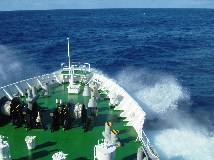
The Japanese research vessel (R/V) "Shigen" ("Resources" in Japanese) is used for energy resource explorations. She has ten streamer cables for seismic survey to image sub-seafloor structures with seismic reflection wave.

Cartoon is here.


Photograph. Very unique forme.


However, the streamer cables were cut by Japanese submarine unfortunately.
(Yahoo News Japan)
http://www.kahoku.co.jp/news/2009/06/20090618t23031.htm

Sevens of the cables were cut, and four have been lost.
(Press release from METI, Japan)
METI Ministry of Economy, Trade and Industry
http://www.meti.go.jp/press/20090619002/20090619002.html
http://www.meti.go.jp/press/20090619011/20090619011.html
http://www.meti.go.jp/press/20090623002/20090623002.html

Although R/V Shigen is not famous in Japan, the name is highlighted again since she was born in 2007. Too bad. Please be famous as your research results, Ms. Shigen!

I heard from a researcher who analyse the 3D seismic data obtained by R/V shigen that he have never get a permission for visiting the vessel.
Why? I cannot understand.

I recommend to make a event of open ship with R/V Shigen. Many people will understand her activity there.

Finally, I introduce websites with photos of R/V Shigen.
Have fun!

http://takaranoumi.blog.so-net.ne.jp/2008-08-02
http://takeuchiflo.kanagawa879.com/blog/2008/06/17/2019
http://karano.exblog.jp/4589496/

This blog is restarted.

I have left this blog with no modificatios.
Again, I'll start the introduction of my Japanese blog in English.

Have fun!

Saturday, June 28, 2008

Difference in seismic intensity between US and Japan

Do you know the seismic intensitiy index is different between contries?

For example...


1) US uses the modified Mercalli intensity (MMI) scale.
The MMI consists from twelve steps (I - XII), decided from
dameges of buildings, bodily sensation of shaking and so on.


2) Japan uses the JMA (Japan Meteorological Agency) intensity scale.
The JMA intensity consists from ten steps (0-7),
decided from the seismometers (ground accelarations).


These two different intensity scale cannot be translated precisely,
however, I tried to translate it rougly. The process is detailed as follows.


1) Access to the web site "Earthquake Hazards Program" produced by USGS
(US Geological Survey). >> http://earthquake.usgs.gov/


2) Go to the ShakeMap. >> http://earthquake.usgs.gov/shakemap/


3) Watch a ShakeMap image.
For example, http://earthquake.usgs.gov/eqcenter/shakemap/global/shake/2008ryan/


4) See a color pallet table below the map,
and find the Estimated Intensity values with unit of PEAK ACC(%g).
Each value approximate represents ground accelaration for each MMI.


5) Modify the unit of PEAK ACC.
1%g=0.01*9.8*100cm/s^2=9.8cm/s^2


6) See the JMA web site. You can see the relationship between JMA intensity
and accelaration in the graph (Fig.3).
http://www.seisvol.kishou.go.jp/eq/kyoshin/kaisetsu/comp.htm
cf. written in Japanese.
Here, we assume the frequency of shaking as 0.5 seconds.
We can easily read the accelaration range for each JMA intensity from Fig.3.

Finally, on the basis of the above 5 and 6, we can make a traslation table
between MMI and JMA intensity as follows.

--------------
MMI:JMA
--------------
I : 0-1
II-III: 1-3
IV : 3
V : 4
VI : 5L
VII : 5H
VIII: 6L
IX : 6H-7
X+ : 7
--------------

Although the translation table is not precise,
you can rougly compare the MMI and JMA intensity quickly.

Try it.

* Original Japanese article
>> http://goto33.blog.so-net.ne.jp/2008-06-09-1

Saturday, March 1, 2008

Put cool photos on your blog!

Although the clip arts appended to MS Office is very frexible and useful, someone may not have the Office softwaere.
How about the following another site?

- Flickr photos with a Creative Commons Attribution License

(Please use the search form with caption of "Creative Commons".)

Various photographs and illustrations created by various people are
presented here with the CC licence.

The "Attribution License" is the most frexible one in the CC licence.
Let's borrow a picture.


Earth Egg by azrainman (protected by CC Licence

Oh, What is the CC licence?

...Continued to original entry (translated by Google)

Sunday, February 24, 2008

Put illustrations on your blog!

Some bloggers feel that their own blogs are cheerless because of
no beautiful photos and funny illustrations.

Don't cry!

Recently, I put many photos and illustrations on my blog.
  

All of them has been obtained via internet.
I modified some of them by myself.
"Did you get permission to the authors?"
Don't worry. We can use them FREELY without any permissions.

Original site is here, the Microsoft.
- Microsoft Office Online (Japan)

...Continued to original entry (translated by Google)

Saturday, February 23, 2008

Mega holiday

I visted "Miraikan", The National Museum of Emerging Science
and Innovation, Tokyo, Japan.


Free shuttleがdrives every 15-20 minitues around the Odaiba
area, including "Miraikan". It'is the easiest way to there.

The purpose of this excursion is ...

The MEGASTAR-II cosmos!
This is a planetarium with five million fixed stars !
At the last visting, I could not get the ticket.
This time, I fortunately obtained it.

Before enjoying MEGASTAR, I ate the different mega.

Super mega burger at Wendy's
Three putties with 300g!

...Continued to original entry (translated by Google)

Saturday, February 16, 2008

Ice in Tokyo

It's too cold everyday in Japan. How do you do?

Lake Suwa, located in the middle of Japan, was frozen totally and
ridges of ice were found through the center of lake.
Local people called the phenomena as "Omiwatari" and
beleive it as the sign of blessedness.

- Lake Suwa: Omiwatari revealed since 2006
http://headlines.yahoo.co.jp/hl?a=20080130-00000012-maip-soci

Ice is fanny material.
I found an ice sheet covering a small pond in Tokyo.

Several meters square.


A rough surface. It implies that the ice sheet has been melted in
day-time and frozen in night-time.
The mechanism is as same as the ice ridge called as "Omiwatari".

...Continued to original entry (translated by Google)

Sunday, February 10, 2008

Balloon mail: emotion and problem

Japanese newspapers tell that a balloon with a mail released 15
years ago was replied by a deep-sea fish.

a flatfish delivered a mail attached to a ballon 15 year ago.
http://headlines.yahoo.co.jp/hl?a=20080124-00000138-mai-soci


A girl released the balloon with her mail, and 15 years later, the mail
was attached on the flatfish and obtained by a fisherman.

What's an impressive story!
A human is not alone. He (or she) connect everywhere and everytime to another human.
However, the story feel me a problem about deep-sea garbage.

Sea-floor is covered by prenty of rubbers, vinyls and plastic materials, isn't it?


...Continued to original entry (translated by Google)

Friday, February 8, 2008

Red sky at Sunrise

Sunrise on the ocean.
I took it when I was on board of the JAMSTEC research vessel
last month.


In the Sagami bay, Japan

I retrieved the ocean bottom gravimeter at that time.

Sunday, February 3, 2008

Sake and Cat in Kyoto

Continued from the previous entry.

After visiting the Ginkaku-ji temple, I went to Fushimi, a small city
located at the southern tip of the Kyoto town.
Fushimi is famous about Japanese rice wine ("Sake").


Walking around the sake brewery.
The steam may be related to making sake.

When I entered a cafe in the Fushimi area,

I saw a cat sitting on a chair.

...Continued to original entry (translated by Google)

Wednesday, January 23, 2008

Walking around the Ginkaku-ji temple

I walked around the Ginkaku-ji temple.


"Road for philosophers" is a famous alley in Kyoto.
I love to walk along the road and the river.

But before the stroll, I went a small restaurant.

"Issen-Yoshoku"
This is an original form of Japanese pizza "Okonomi-yaki".
Put mouse cursol on this photo for the larger image.


...Continued to original entry (translated by Google)

Sunday, January 20, 2008

Very old temple (500 years old!)

At the short stay in Kyoto, I visited the Ginkaku-ji temple.
It was first time for me, although I have climbed the mountain
behind the temple. (The mountain is famous as "Daimonji Yaki".)


The Ginkakku-ji temple. It was originaly a cottage for the Japanese
general, Yoshimasa Ashikaga (1449-1473).


The main building ("Kannon-den"). It looks quite old!


Sand garden. It looks solid and is quite different from the another
famous Kyoto sand garden in the Ryoan-ji temple.


...Continued to original entry (translated by Google)