Monday, July 6, 2009

Melon Bread

Do you know "melon bread" in Japan?
The "melon bread" does not include melon and any fruits, and
does not have the melon taste and smell.

The lower is a typical "melon bread".
Now, you can easily understand the reason.
The surface pattern is similar to the melon itself.

At first, the bread was not called as "melon bread" but "sunrise".
It simulated the shape of sun almost 100 years ago.
After several tens years had passed, the melon fruit become popular and
the name of "sunrise bread" was changed to "melon bread".

The upper bread in the photograph is also called as "melon bread".
It is the original version of the "melon bread" developed about 100 years ago
in Kobe and Kyoto. After the recent version of "melon bread", called as "sunrize"
originally, becomes popular, the original version becomes minor.

Why did Japanese people to make a melon-shaped bread?
About 100 years ago, the fruits of melon was quite rare in Japan.
Also the bread itself was rare. I think both of the melon fruit and bread
are kinds of symbol for "trendy goods" or "mode" at that time.
It is easily understood that a baker tried to combine these novel things
for his new item. This is my guess.


Finally, do you know a Japanese word of "bread".
"Pan".
For example, the "melon bread" is called as "melon pan" in Japanese.
It is not a saucepan made by melon :P

Monday, June 29, 2009

R/V Shigen

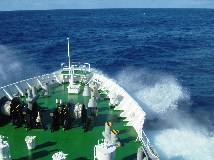
The Japanese research vessel (R/V) "Shigen" ("Resources" in Japanese) is used for energy resource explorations. She has ten streamer cables for seismic survey to image sub-seafloor structures with seismic reflection wave.

Cartoon is here.


Photograph. Very unique forme.


However, the streamer cables were cut by Japanese submarine unfortunately.
(Yahoo News Japan)
http://www.kahoku.co.jp/news/2009/06/20090618t23031.htm

Sevens of the cables were cut, and four have been lost.
(Press release from METI, Japan)
METI Ministry of Economy, Trade and Industry
http://www.meti.go.jp/press/20090619002/20090619002.html
http://www.meti.go.jp/press/20090619011/20090619011.html
http://www.meti.go.jp/press/20090623002/20090623002.html

Although R/V Shigen is not famous in Japan, the name is highlighted again since she was born in 2007. Too bad. Please be famous as your research results, Ms. Shigen!

I heard from a researcher who analyse the 3D seismic data obtained by R/V shigen that he have never get a permission for visiting the vessel.
Why? I cannot understand.

I recommend to make a event of open ship with R/V Shigen. Many people will understand her activity there.

Finally, I introduce websites with photos of R/V Shigen.
Have fun!

http://takaranoumi.blog.so-net.ne.jp/2008-08-02
http://takeuchiflo.kanagawa879.com/blog/2008/06/17/2019
http://karano.exblog.jp/4589496/

This blog is restarted.

I have left this blog with no modificatios.
Again, I'll start the introduction of my Japanese blog in English.

Have fun!

Saturday, June 28, 2008

Difference in seismic intensity between US and Japan

Do you know the seismic intensitiy index is different between contries?

For example...


1) US uses the modified Mercalli intensity (MMI) scale.
The MMI consists from twelve steps (I - XII), decided from
dameges of buildings, bodily sensation of shaking and so on.


2) Japan uses the JMA (Japan Meteorological Agency) intensity scale.
The JMA intensity consists from ten steps (0-7),
decided from the seismometers (ground accelarations).


These two different intensity scale cannot be translated precisely,
however, I tried to translate it rougly. The process is detailed as follows.


1) Access to the web site "Earthquake Hazards Program" produced by USGS
(US Geological Survey). >> http://earthquake.usgs.gov/


2) Go to the ShakeMap. >> http://earthquake.usgs.gov/shakemap/


3) Watch a ShakeMap image.
For example, http://earthquake.usgs.gov/eqcenter/shakemap/global/shake/2008ryan/


4) See a color pallet table below the map,
and find the Estimated Intensity values with unit of PEAK ACC(%g).
Each value approximate represents ground accelaration for each MMI.


5) Modify the unit of PEAK ACC.
1%g=0.01*9.8*100cm/s^2=9.8cm/s^2


6) See the JMA web site. You can see the relationship between JMA intensity
and accelaration in the graph (Fig.3).
http://www.seisvol.kishou.go.jp/eq/kyoshin/kaisetsu/comp.htm
cf. written in Japanese.
Here, we assume the frequency of shaking as 0.5 seconds.
We can easily read the accelaration range for each JMA intensity from Fig.3.

Finally, on the basis of the above 5 and 6, we can make a traslation table
between MMI and JMA intensity as follows.

--------------
MMI:JMA
--------------
I : 0-1
II-III: 1-3
IV : 3
V : 4
VI : 5L
VII : 5H
VIII: 6L
IX : 6H-7
X+ : 7
--------------

Although the translation table is not precise,
you can rougly compare the MMI and JMA intensity quickly.

Try it.

* Original Japanese article
>> http://goto33.blog.so-net.ne.jp/2008-06-09-1

Saturday, March 1, 2008

Put cool photos on your blog!

Although the clip arts appended to MS Office is very frexible and useful, someone may not have the Office softwaere.
How about the following another site?

- Flickr photos with a Creative Commons Attribution License

(Please use the search form with caption of "Creative Commons".)

Various photographs and illustrations created by various people are
presented here with the CC licence.

The "Attribution License" is the most frexible one in the CC licence.
Let's borrow a picture.


Earth Egg by azrainman (protected by CC Licence

Oh, What is the CC licence?

...Continued to original entry (translated by Google)

Sunday, February 24, 2008

Put illustrations on your blog!

Some bloggers feel that their own blogs are cheerless because of
no beautiful photos and funny illustrations.

Don't cry!

Recently, I put many photos and illustrations on my blog.
  

All of them has been obtained via internet.
I modified some of them by myself.
"Did you get permission to the authors?"
Don't worry. We can use them FREELY without any permissions.

Original site is here, the Microsoft.
- Microsoft Office Online (Japan)

...Continued to original entry (translated by Google)

Saturday, February 23, 2008

Mega holiday

I visted "Miraikan", The National Museum of Emerging Science
and Innovation, Tokyo, Japan.


Free shuttleがdrives every 15-20 minitues around the Odaiba
area, including "Miraikan". It'is the easiest way to there.

The purpose of this excursion is ...

The MEGASTAR-II cosmos!
This is a planetarium with five million fixed stars !
At the last visting, I could not get the ticket.
This time, I fortunately obtained it.

Before enjoying MEGASTAR, I ate the different mega.

Super mega burger at Wendy's
Three putties with 300g!

...Continued to original entry (translated by Google)